

Logos Bible Software provided me with a complimentary Pro Subscription extension to facilitate this honest review. While I received access to the software for free, all opinions, testing results, and recommendations in this article are 100% my own. Additionally, this post contains affiliate links. If you choose to purchase a subscription through these links, I may earn a small commission at no extra cost to you, which helps support the ministry of Simple Theology, Messy Life.
When I first opened my email and saw the message from Logos, I’ll admit that I felt both honored and excited. The team at Logos had invited me to participate in beta testing for upcoming features, which prompted me to write this Logos Bible Software review.
Their message was clear: they value user feedback and want to continue refining their tools to serve those of us who spend significant time in God’s Word.
Reading their communication, I was struck by the collaborative spirit behind it. Logos is inviting real users – pastors, teachers, students, and researchers – to help shape the tools that will serve the global Church. That kind of humility and intentionality tells me they understand that Bible study software shouldn’t be about slick features or impressive technology, but about equipping God’s people to know Him better through His Word.
With that context in mind, I wanted to offer an updated, thorough review of the Logos Bible Software Pro Subscription. In this review, I aim to honestly evaluate features, benefits, pricing, and overall value for those of us engaged in serious Bible study, from personal study and leading your family to teaching, preaching, and ministry.
What Is Logos Bible Software?
Before diving into the specifics, let’s establish what we’re talking about. Logos Bible Software is a digital library and research platform designed to help users study the Bible with depth, accuracy, and efficiency. The Pro Subscription sits in the middle tier of Logos’ three subscription levels (Premium, Pro, and Max), and it’s specifically designed for pastors, Bible teachers, and anyone engaged in regular sermon preparation or teaching ministry.
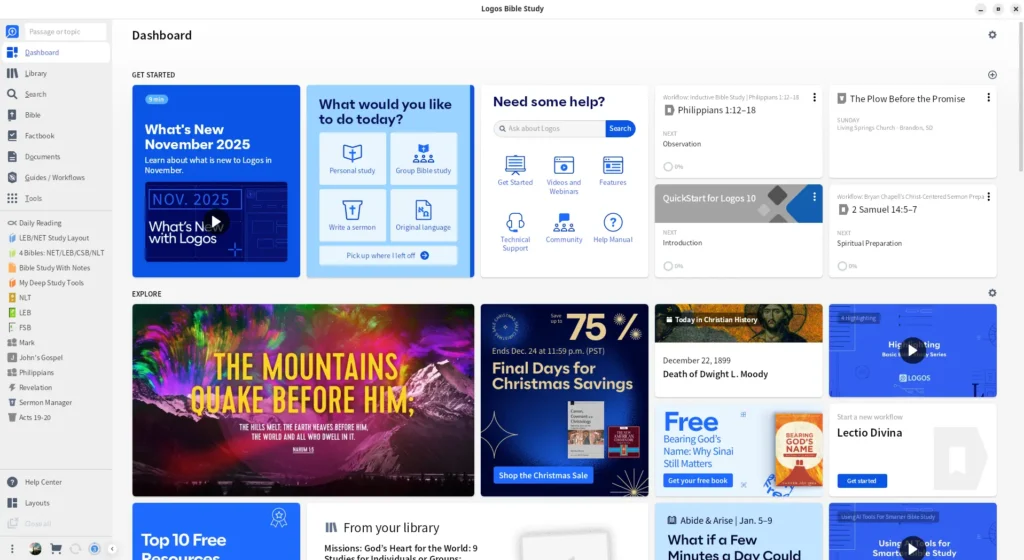
At $14.99 per month (or $12.50/month when billed annually at $149.99) at the time of this review, the Pro plan offers a powerful suite of study tools, access to over 500 curated books, original language resources, sermon prep features, and exclusive subscriber perks, all for less than the cost of a couple of commentaries each year.
The subscription model is a game-changer for many people because it removes the upfront cost that used to be a barrier for many pastors and students. Instead of spending thousands on a base package, you can access cutting-edge tools and a growing library for a manageable monthly or annual fee.
And if you stay subscribed for 24 consecutive months, you receive a Legacy Fallback License, which allows you to retain offline access to many features even if you cancel. This is a generous safety net that shows Logos values long-term users.
Who Is the Pro Subscription For?
Logos Pro is perfect for:
- Pastors and preachers preparing weekly sermons who need quick access to commentaries, original languages, sermon outlines, and illustrations
- Bible study leaders crafting lessons for small groups or Sunday school classes
- Missionaries and church planters who need robust study tools without the budget for large libraries
- Seminary students and ministry leaders doing intermediate-level theological and exegetical work
- Devoted personal Bible students who want to go deeper than surface-level devotionals
If you’re someone who takes the Bible seriously and wants to teach it faithfully, Logos Pro gives you the tools to do that well, without requiring a PhD or a huge budget.
5 Key Features That Make Logos Pro Stand Out
1. Sermon Preparation Made Simple
One of the standout features of the Pro subscription is its sermon preparation workflow. As someone who has preached in multiple contexts in churches in Europe and the United States, I can tell you that effective sermon prep requires depth and efficiency. Logos Pro delivers both.
The Sermon Builder tool allows you to outline your message, pull in Scripture references, insert quotes from commentaries, add illustrations, and even embed media, all in one place. Everything is integrated in one app and searchable.

Imagine you’re preaching through the book of Ephesians. You select your passage, and Logos immediately surfaces relevant commentaries, cross-references, word studies, historical background, and preaching resources. You can compare multiple translations side-by-side, check the original Greek, and explore how key terms are used elsewhere in Scripture. You can do this all within minutes.
For busy pastors balancing visits, counseling sessions, and leadership meetings, this kind of efficiency is a game-changer. It doesn’t replace the work of prayer, meditation, and listening to the Holy Spirit, but it does provide a huge assist in your research so you can focus on crafting a message that speaks to your congregation’s real needs.
2. Original Language Tools Without the Overwhelm
One of my favorite aspects of Logos Pro is how it makes Greek and Hebrew accessible to those of us who aren’t language scholars. You don’t need years of seminary training to benefit from the original languages because Logos bridges that gap well.
The Interlinear Bible allows you to hover over any English word and instantly see the underlying Greek or Hebrew term, along with its morphology (grammatical form), definition, and how it’s used throughout Scripture. If you’re teaching on a passage like John 3:16 and want to understand the nuances of agape love, you can explore that depth without pulling out lexicons and parsing guides.
The Word Study tool goes even further, showing you every occurrence of a word, its semantic range, related terms, and how different translations render it. This is invaluable when you’re trying to communicate the richness of a biblical concept to a modern audience.

For example, when teaching about Jesus as the “Logos” (Word) in John 1:1, understanding how that term was used in both Jewish and Greek contexts enriches your teaching immensely. Logos Pro gives you that insight without requiring you to be fluent in ancient languages.
The Word Study Tool is one of my own most-used resources in my own Logos subscription.
3. Access to Over 500 Curated Books

While the subscription model focuses on tools, Logos Pro also includes access to a curated library of over 500 books which includes commentaries, Bible dictionaries, theological works, and historical resources. This library grows over time as Logos adds new titles.
Among the resources you’ll find are the Logos Research Commentaries, which provide scholarly, accessible insights into biblical texts. These are serious exegetical resources that help you understand the original context, literary structure, and theological message of each passage.
Additionally, subscribers get access to Mobile Ed courses tailored to their subscription level. These video courses cover topics like hermeneutics, biblical theology, church history, and practical ministry, each one taught by leading scholars and practitioners. It’s like having a seminary living in your computer.
And here’s a nice bonus: while subscribed, you save an extra 5% on all book purchases. So if you want to add a specific commentary or theological work to your personal library (which you’ll own forever), you get a discount simply for being a subscriber.
4. Smart Search and AI-Powered Tools
Logos has integrated AI technology thoughtfully and responsibly into their platform. The Smart Search feature allows you to ask questions in natural language like “What does the Bible say about anxiety?” – and get relevant results instantly.
The Summarize Tool can condense lengthy articles or chapters into digestible summaries, helping you quickly determine whether a resource is relevant to your study. This is particularly helpful when you’re pressed for time and need to sift through multiple sources.
I appreciate that Logos has been careful and transparent about their use of AI, emphasizing that technology should assist but not replace the Spirit-led work of study and discernment. The tools are designed to help you find answers faster, not to shortcut the process of wrestling with Scripture.
5. Exclusive Subscriber Perks
Beyond the core features, Logos Pro subscribers enjoy several exclusive benefits:
- An extra free book every month (in addition to the monthly free book available to all users)
- Access to Logos Sermons, a growing collection of sermon outlines, illustrations, and media
- 5% annual reward coupon for Pro and Max subscribers – each February, you receive a coupon worth 5% of all qualifying purchases made while subscribed the previous year
- Early access to new features and beta testing opportunities
These perks add real value over time. The monthly free book alone could be worth $10-$30, and the 5% annual reward means your spending on additional resources gets rewarded, essentially giving you a loyalty bonus for investing in your library.
Pricing and Value: Is Logos Pro Worth It?
Logos Bible Software – Pro Subscrption
Publisher
Faithlife
Format MacOS, Windows, iOS, Android, Web

Let’s talk dollars and sense. At $12.50 per month (billed annually), Logos Pro costs $149.99 per year. That’s less than many pastors and teachers spend on a single commentary set or a weekend conference.
Compare that to the cost of building a comparable physical library:
- A good commentary set: $200-$500
- Greek and Hebrew lexicons: $100-$150
- Bible dictionaries and theological references: $150-$300
- Sermon illustration books: $50-$100
You’re easily looking at $500-$1,000+ just to assemble a basic working library…and that’s before you factor in the space to store it, the time to search through it, and the inability to take it with you on a hospital visit or mission trip.
With Logos Pro, you get all of that plus advanced search capabilities, original language tools, sermon prep workflows, and regular updates for a fraction of the cost. And because it’s cloud-based, your library syncs across all your devices: desktop, laptop, tablet, and smartphone. Whether you’re studying in your office, preparing notes at a coffee shop, or pulling up a cross-reference during a hospital visit, everything is at your fingertips.
The Legacy Fallback License: A Safety Net
One concern many people have about subscription software is the “what if I cancel?” question. Logos generously handles this with the Legacy Fallback License. If you subscribe continuously for 24 months and then cancel, you retain offline access to many of the features (those that don’t rely on cloud or AI functionality). You won’t get future updates or new features, but your software won’t disappear.
This is a generous policy that shows Logos isn’t just trying to lock you into a never-ending payment cycle. They genuinely want to serve the long-term needs of their users.
Real-World Use Cases
Let me illustrate how Logos Pro works in practice with a few scenarios:
Scenario 1: Weekly Sermon Prep
Pastor Bill is preaching through the Gospel of Mark. On Monday morning, he opens Logos and selects his text: Mark 10:17-31 (the rich young ruler). Logos automatically generates a Passage Guide, surfacing relevant commentaries, cross-references, historical context, and theological themes.
He uses the Sermon Builder to outline his message, pulling in quotes from commentaries, noting Greek insights on key words like “eternal life” and “treasure in heaven,” and adding a modern illustration about materialism. By Tuesday afternoon, he has a solid draft, freeing up the rest of the week for prayer, refinement, and pastoral care.
Scenario 2: Small Group Bible Study
Sarah leads a women’s Bible study at her church. This week, they’re studying Philippians 4:6-7. She uses Logos to explore the meaning of “supplication” and “peace,” comparing translations and checking the original Greek. She finds a great illustration about anxiety from a commentary and generates discussion questions using Logos’ AI tools.
When the group meets, Sarah is prepared to guide a rich conversation, and not because she spent 10 hours researching, but because Logos helped her find what she needed efficiently.
Scenario 3: Academic Research
David is a seminary student writing a paper on Paul’s theology of justification. He uses Logos Pro to search across hundreds of resources for references to “justification,” “righteousness,” and related terms. The Search and Word Study tools help him trace the theme through Romans, Galatians, and the rest of Paul’s letters. He exports his notes and citations directly into his paper, saving hours of manual work.
Logos Pro vs. Premium and Max: How to Choose
Logos offers three subscription tiers. Here’s a quick comparison to help you decide:
- Premium ($8.33/month annually): Best for small group leaders and personal Bible study. Includes 250+ books, basic search, devotional tools, and discussion question generators. Great for laypeople who want more than a basic Bible app but don’t need advanced tools.
- Pro ($12.50/month annually): Perfect for pastors, teachers, and serious students. Adds sermon prep tools, intermediate Greek and Hebrew resources, access to 500+ books, Logos Sermons, and teaching aids. This is the sweet spot for most ministry leaders.
- Max ($16.67/month annually): Ideal for scholars, researchers, and those doing advanced language study. Includes 600+ books, advanced morphology and syntax tools, and resources for Latin, Coptic, and Syriac. If you’re writing academic papers or doing PhD-level research, Max is worth the upgrade.
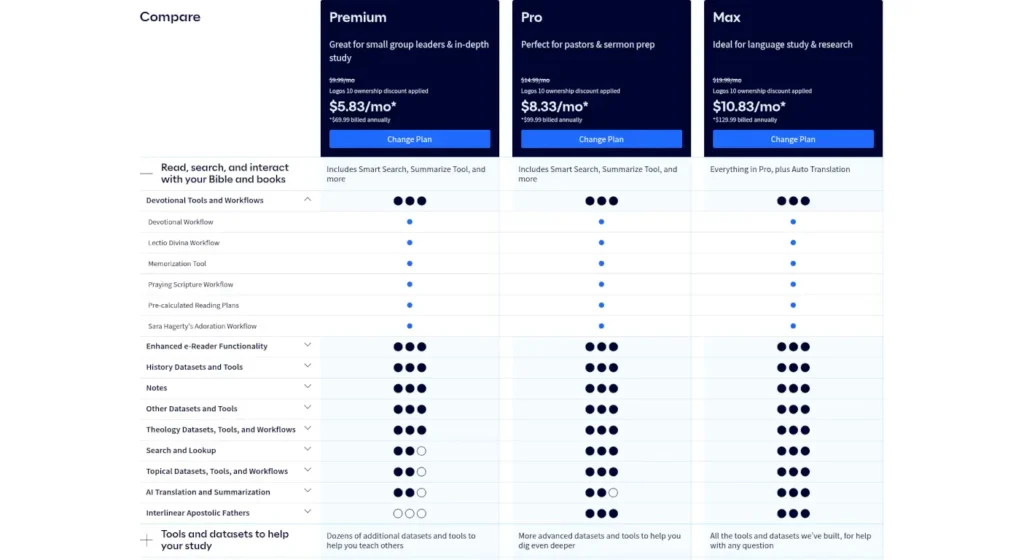
For most pastors and Bible teachers, Pro offers the best balance of features and affordability. You get robust original language tools without the complexity of advanced academic features you may not use. And if you find you need more down the road, you can always upgrade.
A Few Honest Limitations
No software is perfect, and Logos Pro has a few limitations worth noting:
- Learning Curve: Logos is incredibly powerful, but that power comes with complexity. New users can feel overwhelmed at first. Thankfully, Logos offers free training webinars, tutorials, and a robust help center to guide you.
- Internet Dependence: Many features require an internet connection, especially AI and cloud-based tools. If you’re in a remote area with limited connectivity, this can be a challenge (though offline access is available for many resources).
- Subscription Fatigue: Some users prefer to own software outright rather than subscribe. If you’re philosophically opposed to subscriptions, Logos still offers traditional base packages – but you’ll miss out on the affordability and flexibility of the subscription model.
Final Recommendation: Should You Subscribe to Logos Pro?
If Logos Pro sounds like the right tool for your study and ministry, the best way to evaluate it is to use it yourself.
If you’re a pastor, teacher, or serious student of Scripture, I wholeheartedly recommend Logos Bible Software Pro Subscription. It offers exceptional value, combining powerful study tools, a growing library, and exclusive perks, all for a price that’s accessible to most ministry budgets.
The Pro plan provides the perfect balance: robust enough for weekly sermon prep and teaching, affordable enough for small church budgets or missionaries, and user-friendly enough that you don’t need a seminary degree to use it.
More importantly, Logos Pro helps you do what you’re called to do: faithfully handle the Word of Truth (2 Timothy 2:15). It doesn’t replace the work of prayer, meditation, and dependence on the Holy Spirit, but it equips you to study more deeply, teach more clearly, and serve more effectively.
In today’s world, many pastors are overworked and under-resourced. Logos Pro is a tool that genuinely helps. It saves time without sacrificing depth. It makes advanced scholarship accessible without dumbing it down, and it grows with you as your ministry and study deepen.
If you’ve been on the fence about Logos, I encourage you to start with the 30-day free trial. Dive into a passage you’re teaching soon, explore the tools, and see how they enhance your study. My guess is that by the end of the trial, you’ll wonder how you ever managed without it.